






Ask the MCC Expert appears in each issue of Community Magazine, where we invite MCC faculty and instructors to share practical tips on subjects they’re passionate about. Faculty and instructors are encouraged to reach out to Brian Ayers, Community editor, at bmayers@mccneb.edu to propose a topic.
Boost your photography skills to take better stills
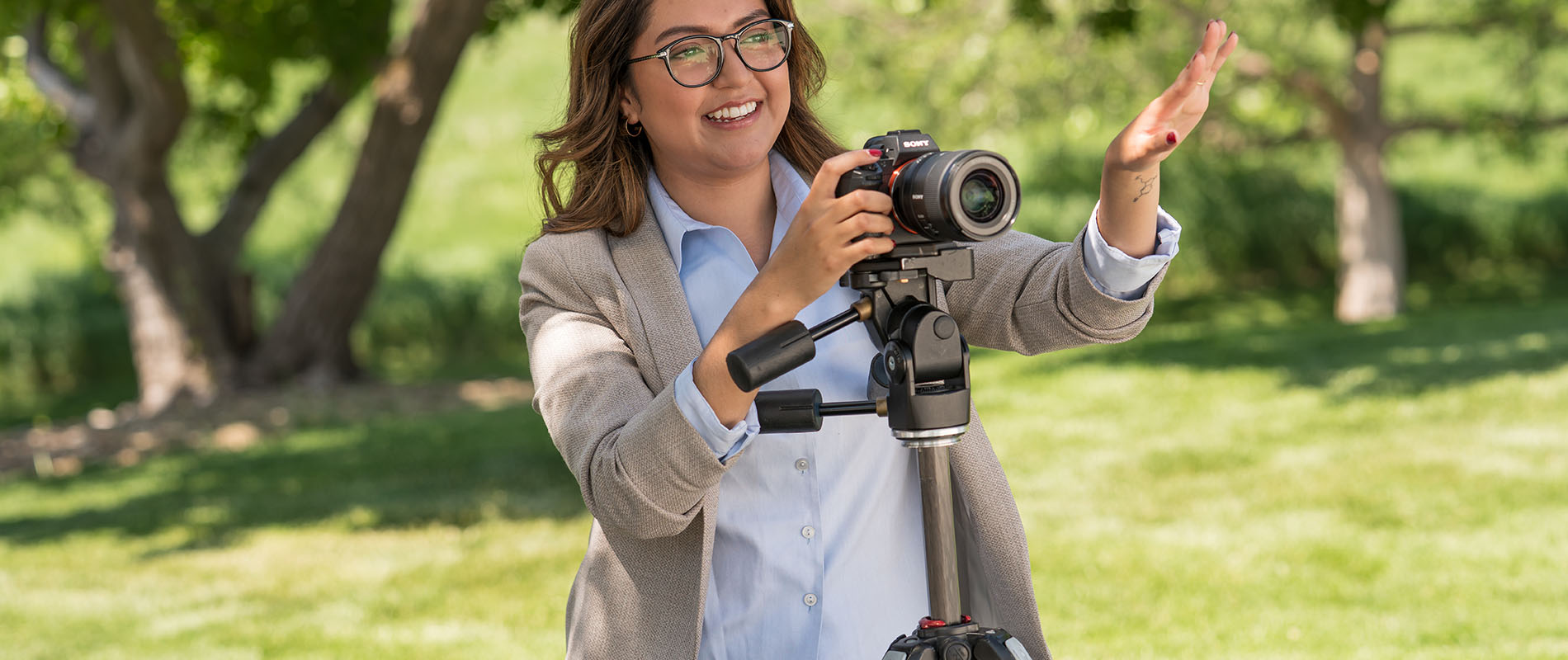
Two decades of exploring photography has taught MCC instructor Adam Dienst-Scott that perspective is key. He shares five tips for developing a stronger photographic eye.
Like many students, Dienst-Scott found his love for photography by happenstance while studying theater education at Emporia State University in Emporia, Kansas.
“I just happened to come across an old Pentax SLR camera and I needed a humanities credit for my degree,” he said. “I took a dark room class and that’s when I fell in love with it ... it changed what I wanted to teach.”
After finishing his senior thesis, Dienst-Scott was prepared to begin student teaching when he was offered a spot in the inaugural photography master’s program at Kansas State University. After receiving his master’s degree, he began teaching photography at MCC.
Since then, smartphones with built-in cameras have become increasingly more advanced and popular.
In November 2024, Pew Research Center reported that 91% of Americans have a smartphone, up from 35% in the Center’s first survey on smartphone ownership in 2011. That means that 9 in 10 Americans have access to a highly sophisticated camera — bypassing the need for specialized camera equipment and training for “everyday” photography.
Sharing photos is also easier than ever with social media. In fact, some reports note that 95 million images are uploaded to Instagram daily. With so much image sharing going on all the time, let’s take a moment to talk quality.
Find the unique scene and perspective
Dienst-Scott said the first thing to consider is your ‘why.’
“If you’re walking down the sidewalk or driving down the street and something catches your eye so much that you have to stop and pull out your camera, you need to figure out what it is about that moment that made you stop,” he said.
For example, was it the way that the light hit the trees or the shapes of skyline buildings that caught your eye?
Identifying what appeals to you will allow you to create a strategy for capturing the moment confidently. Then, consider how your perspective is unique.
“I think we have a tendency to always shoot from eye level,” he said. “If you’re trying to show how big something is, or show how important someone is, shoot from below... give your subject a dominant angle.”
No film required — embrace having a wide margin for error
Your perspective is unique and figuring out how to express it takes time and effort. To begin to understand your style, Dienst-Scott recommends creating a gallery — either digitally or physically — of photos that pull you in.
“If you want to take better photographs, identify the ones that you are drawn to and why. Then figure out how to do it and make it your own,” he said.
Because modern cameras and smartphones let you take and erase hundreds of photos with the push of a button, the best way to learn is to simply start.
“You have unlimited tries to get the photo you want,” Dienst-Scott said. “Shoot vertically, shoot horizontally, shoot at an angle. Take the same photo as many times as you want because in one of those photos will be the photo that captures what you want.”
Watch for the right moment
In his experience, Dienst-Scott said most people aren’t comfortable in front of the camera, leading to stiff photos that don’t capture a person’s natural, authentic self.
He recommends giving the subject a countdown but taking a few photos before and after the count is complete — “when people are more relaxed and a bit more natural.”
“When I’m working in my studio and I have a couple in front of me, I’m always watching through the viewfinder,” Dienst-Scott said. “There might be a moment where their hands touch or one of them puts an arm around the other. That’s the shot.”
Plan when you can
You can’t always control what types of photos you’ll get, but planning can help increase your chances of getting the photos you want.
For example, if you’re shooting subjects outside, avoid doing so at noon. Not only can the heat be uncomfortable, but the direction of the light is lackluster.
“It’s going to make everybody look like skeletons because skin tones get washed out and the shadows from eyebrows make the eyes look hollow,” Dienst-Scott said.
Instead, time your outdoor shots for “golden hour.” Golden hour is the time shortly after sunrise or before sunset when the light is softer and more diffused.
“If you have to shoot in the middle of the day, find some open shade,” he said.
If you’re working with groups of people, try to find a space where the lighting is even across the entire group to avoid shadows across faces. In the same vein, pay attention to what’s going on in the background of your landscape.
“Don’t pose grandma in front of a tree whose branches will make her look like she has antlers,” Dienst-Scott said.
Don’t be afraid of technology
No matter your level of experience, there will always be times when one or two details affect the overall aesthetics of an otherwise great photo.
Luckily, smartphones come with dozens of preloaded filters, and external editing tools like Canva and Photoshop have become more advanced and accessible.
“There’s nothing wrong with using those digital apps to help get your intent across,” he said. “Don’t be scared of technology, embrace it.”
For example, one challenge that can be remedied thanks to technology is lighting. With a click of a button, smartphone filters and software applications can automatically adjust for the desired lighting.
Other widely used functions available on your smartphone or via editing software include contrast, saturation and exposure.
Contrast refers to the difference between light and dark areas, which Dienst-Scott said can help boost details and enhance textures.
“Be careful because too much contrast can cause your images to look pixelated,” he said.
Saturation will increase or decrease the vibrancy of a color. For example, it’s a great way to make water look even bluer.
Lastly, exposure affects the overall brightness of the image.
“Editing is helpful in allowing you to regain details that might have been lost when you took the original photo,” Dienst-Scott said.
The MCC Photography program is part of the College’s Creative Arts and Design Academic Focus Area. Visit mccneb.edu/CreativeArts to see full offerings and learn more about the photography program.