

Capstone project puts service learning at center of MCC student experience

Savannah Behrends
Copywriter and features editor | February 16, 2026




Not every class concludes with the physical representation of a full year of hard work, but that’s exactly what happens for students in the Construction Capstone course at Metropolitan Community College.
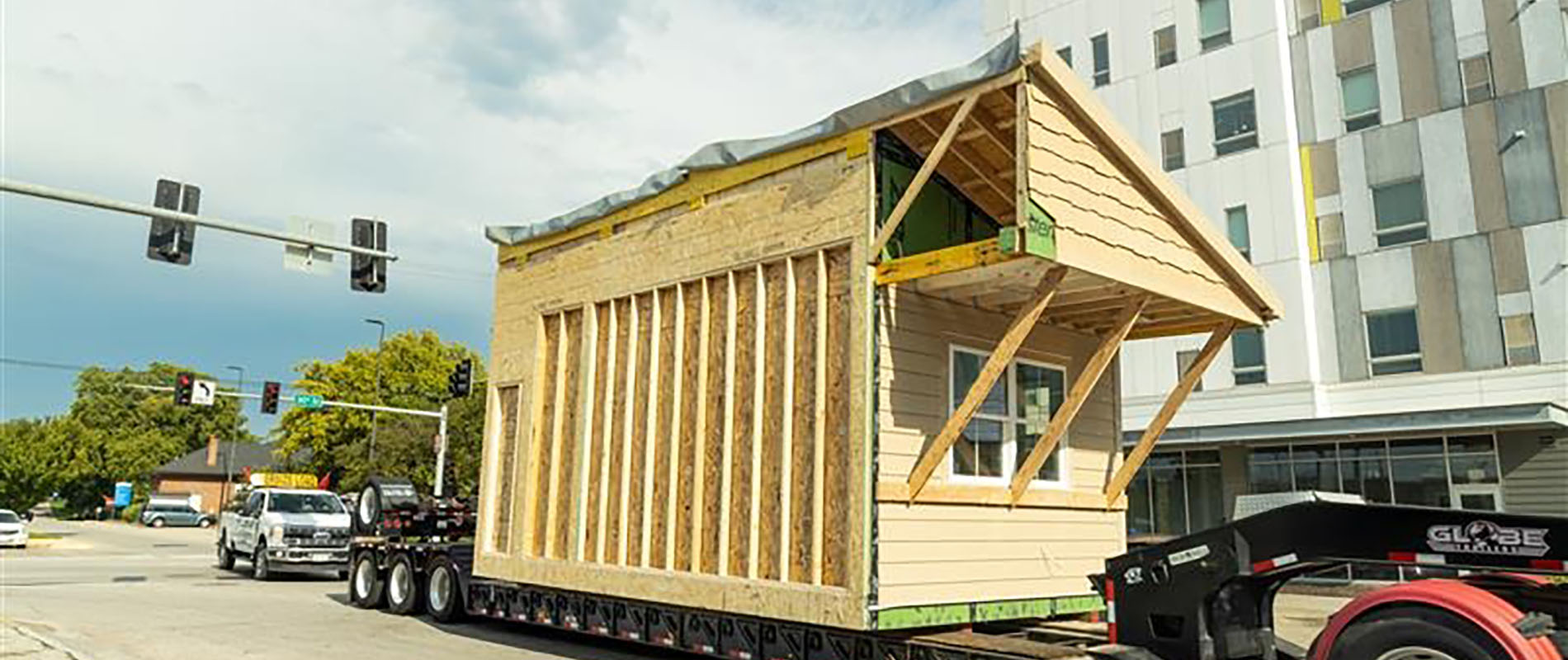
This year, more than 170 students — representing construction and building science technology, plumbing, architecture and electrical programs — gained real-world experience when they helped complete a workforce-ready house for Holy Name Housing Corp (HNHC).
This is the second year the organizations have partnered to provide this service-learning experience. In this agreement, HNHC pays for the physical materials and provides the project scope and MCC students deliver a high-quality home to be placed in the community. The project is completed over the course of a four-quarter academic year.
For Nathan Friedly, the opportunity to learn while supporting his community aligns with his personal goals. After serving in the military for 10 years, Friedly returned to Nebraska and is interning with Habitat for Humanity.
“This is my way of coming back to Nebraska and helping my community out,” he said.
A challenging project

This year, the Architecture Design Technology students were challenged when HNHC provided a narrow lot in the Miller Park Neighborhood (2452 Camden Ave.). HNHC Executive Director Matthew Cavanaugh said the nonprofit is working to create affordable, workforce-ready housing opportunities in desirable areas.
“There’s not a lot of housing stock that doesn’t get gobbled up by investors, and when there are properties, they’re older homes that need a lot of work and investment,” Cavanaugh said. “So we’re bringing something affordable to show that there is market demand for middle-income housing.”
Through a combination of private and public funding and its partnership with MCC, HNHC can keep costs low and quality high while supporting skilled trades and architecture students.
To create a home that fit into the neighborhood, architecture students crafted a single-story, 1,259-square-foot gable roof design with a small, covered front porch and large windows throughout.
“The students wanted to increase the perception of interior space without increasing the house’s footprint on-site, so they opted for an open-concept floor plan with a vaulted ceiling for the communal spaces — kitchen, dining and living room,” Ling said. “The design decision makes the house feel larger and completely removes the feeling of it being a modular home.”
The two-bedroom, one-and-a-half bath residence includes main-floor laundry and flex space.
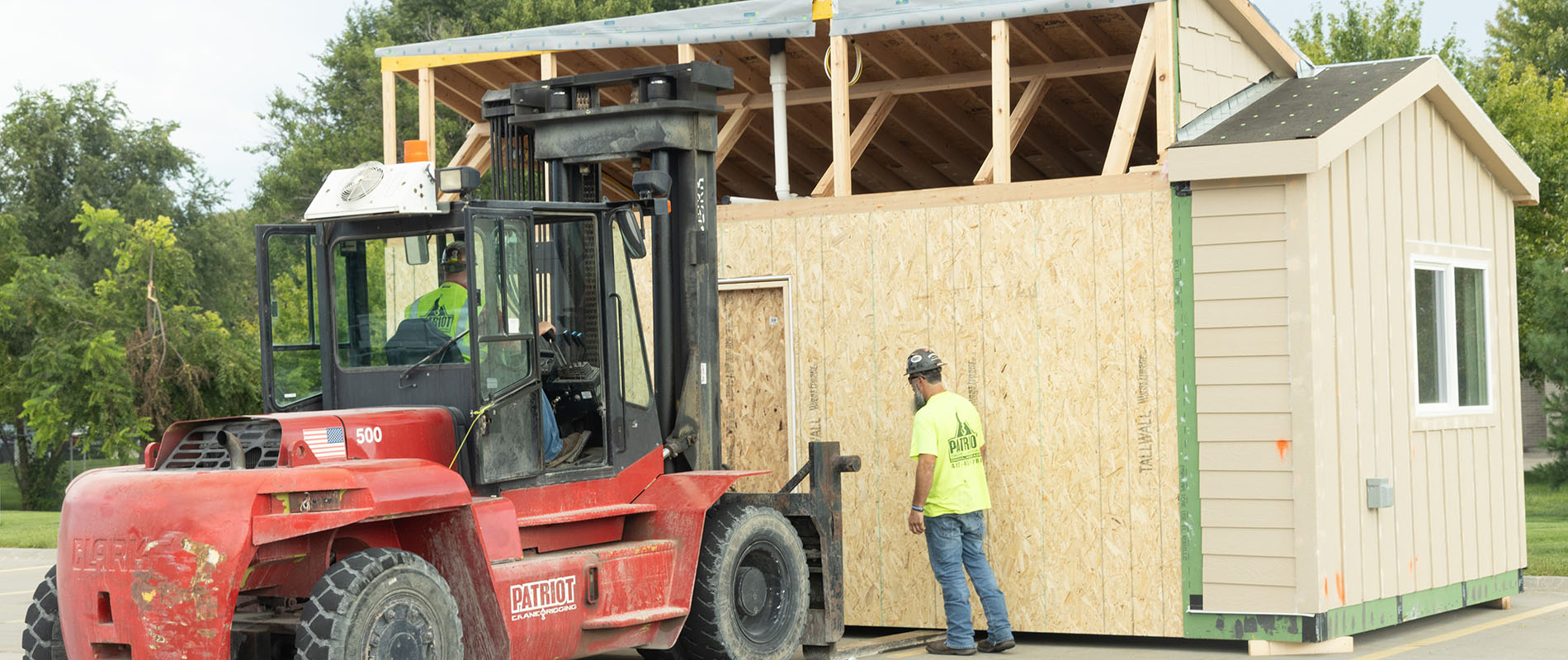
Homes built at the MCC Construction Education Center (Building 25) on the Fort Omaha Campus are built in four sections, called modules, and are moved to their permanent location one section at a time, then assembled on site.
To accommodate for the narrow lot size, architecture students had to create a new configuration that connected four modules at the center, which created a “somewhat complex structural situation.”
“The students and construction instructors had to work closely to address this added complexity without calling unwanted attention to the area,” Ling said.
A classroom that doubles as a jobsite
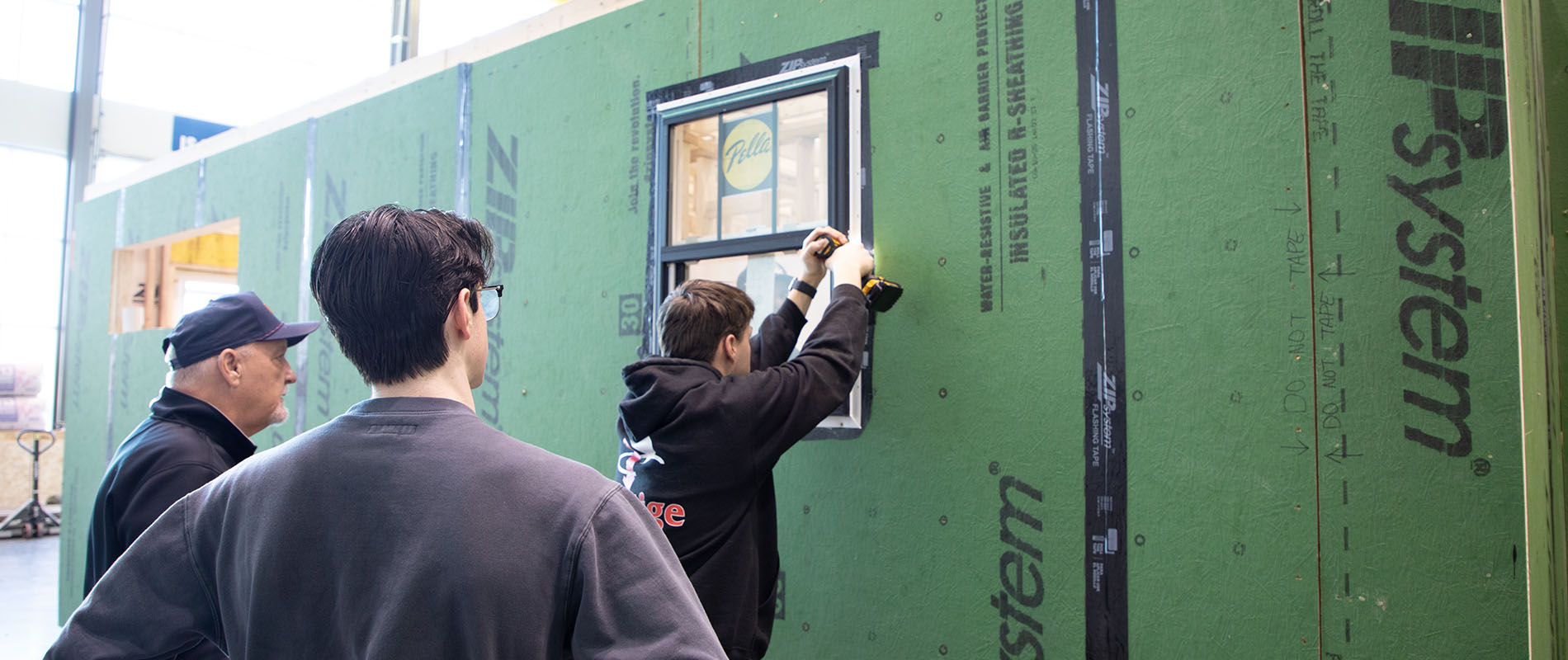
Andrew Henrichs, an MCC Construction and Building Science faculty member who led the project, said students are treated like employees on a jobsite to simulate a real-world experience.
“A big part of this class is teaching students that not every part of construction is enjoyable, but the stuff that seems boring is what makes a build high quality,” Henrichs said.
Being able to physically see those connections is one of the reasons this capstone project is key for students.
“You get to see how everything ties together — all the small details, like caulking, all the siding and trim. It may seem mundane, but it’s needed to fill in all the gaps and make sure everything is waterproof,” said Construction and Building Science Technology student Luis Roman.
Before joining the program, Roman was a maintenance technician for a local apartment complex when he got an idea — he could do the work himself as a homebuilder or home renovator. Completing the program has not only taught Roman what it takes to build a home, but more importantly, that he has what it takes to build a home.
Career pathways
No stranger to the construction industry, Gigi Miedl was confident in following her father’s footsteps into the construction field. But she wasn’t sure if she wanted to go to college before joining the workforce.
Learning about the College’s Walter Scott, Jr. Career Pathway Scholarship, touring its Construction Education Center and learning about available programs changed her mind.
“I’m a visual learner — learning things in the classroom would just go in one ear and out the other,” she said. “With this program, I get hands-on experience before getting onto a jobsite.”
Through the workforce-readiness scholarship program, Miedl learned about potential employment and career opportunities. After completing her associate, she plans to go to Wayne State College before applying to either JE Dunn or Kiewit Corporation.
“I want to start out on a jobsite and get experience there before becoming a superintendent or something like that,” she said. “Kiewit has a program where you travel around to different jobsites for five years.”
Friedly, who expressed a desire to join Habitat for Humanity full-time after completing his degree, found a passion for framing and carpentry during the program.
“If somebody wants to get involved in framing, concrete, cabinetry or any form of construction, this is a great program to get your foot in the door and start building foundational knowledge,” he said.
The programs featured in this article are part of the Skilled Trades and Technical Sciences Academic Focus Area at MCC. Head to mccneb.edu/SkilledTrades to learn more about full offerings for these programs.